Property tax bills are arriving in mailboxes nationwide this fall, and what homeowners owe depends largely on where they live.
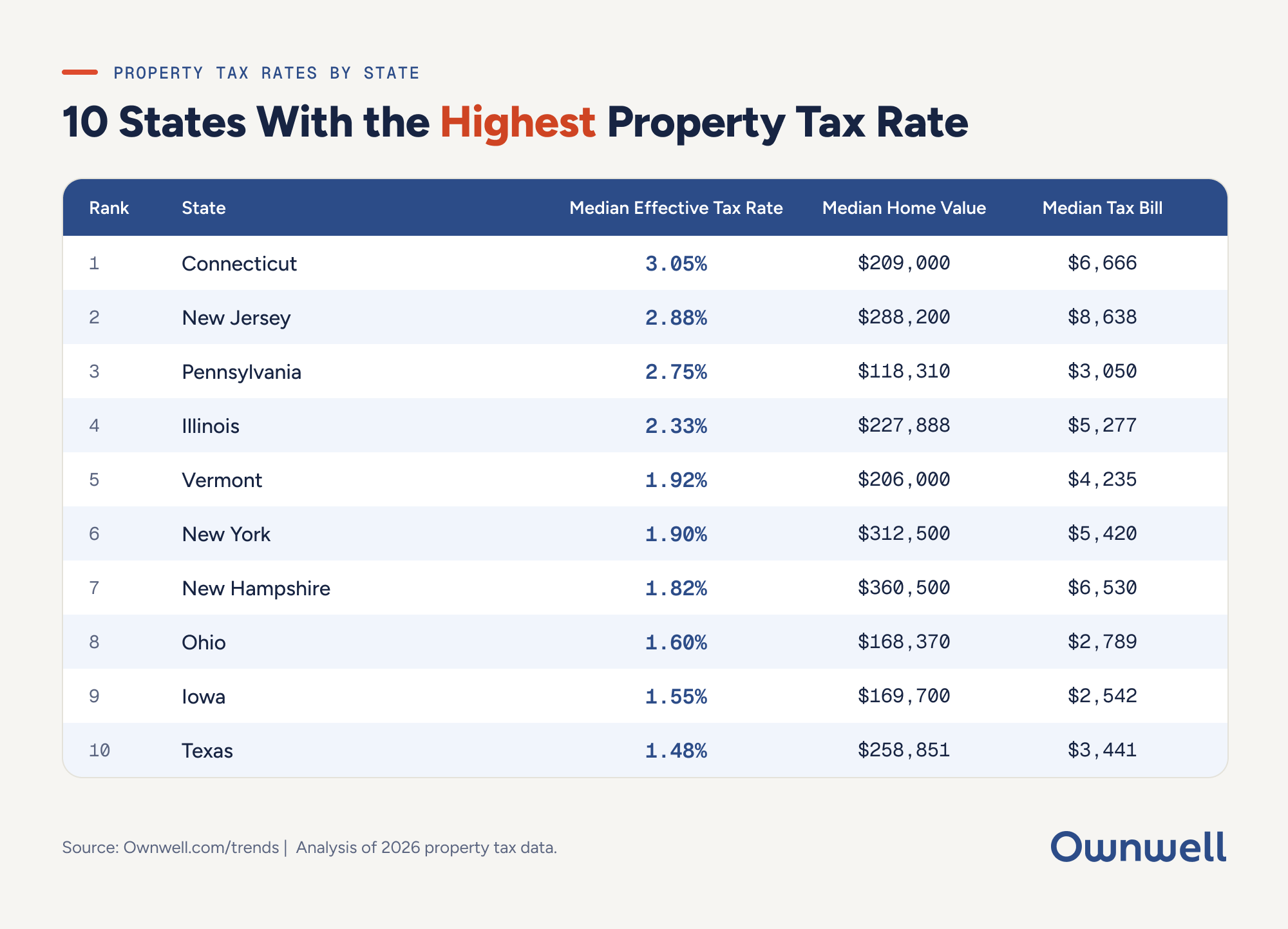
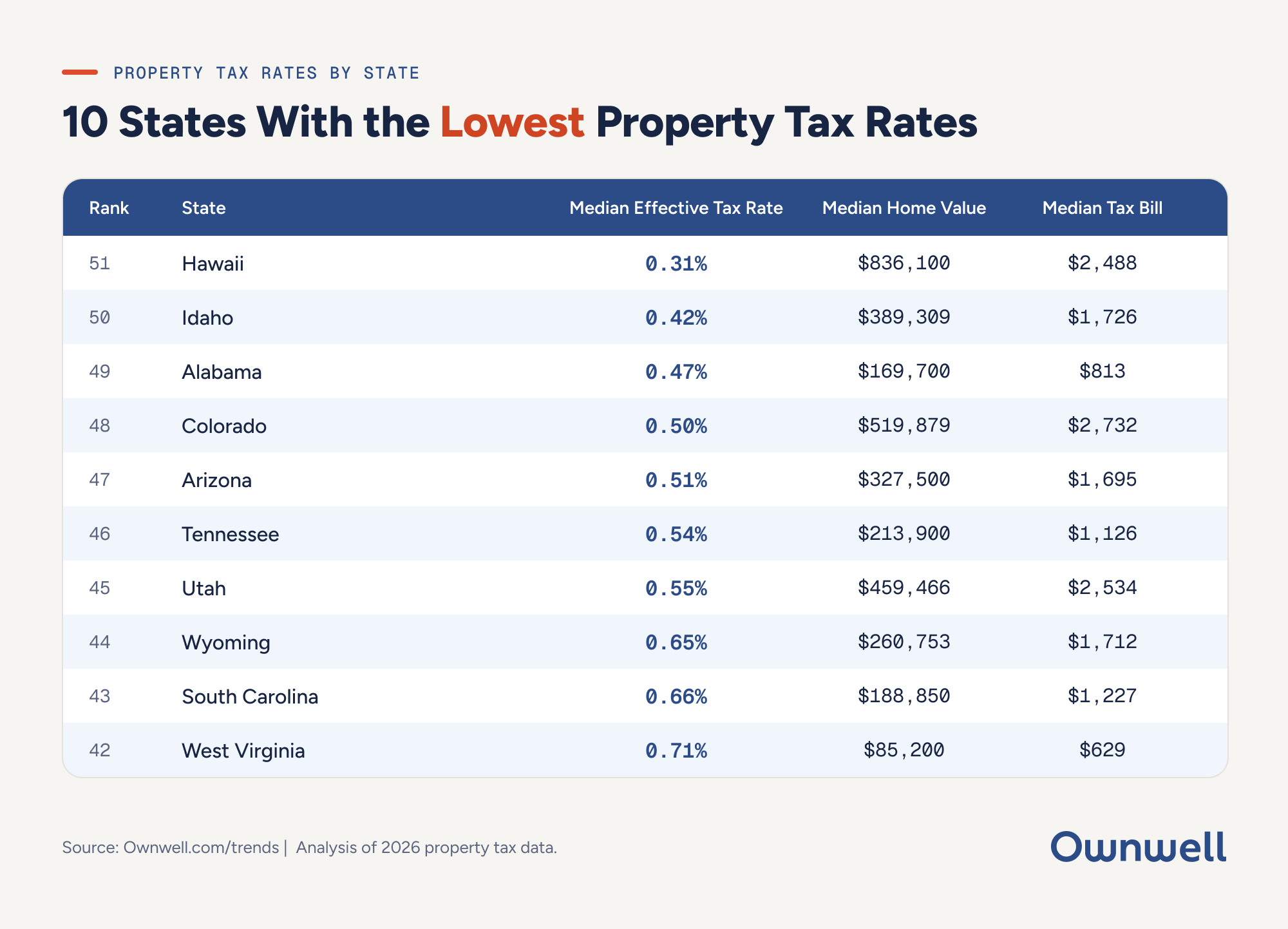
For instance, Connecticut homeowners pay a median effective property tax rate of 3.05%, the highest of any state analyzed, according to our 2026 property tax trends data. Hawaii homeowners have the lowest rate at 0.31%.
And the timing matters. In Texas, bills go out in October and November and are due Jan. 31. Florida mails bills November 1. And while homeowners settle this year's bill, next year's is already taking shape: In many states, including Texas, Florida, Illinois, and Washington, a home's taxable value is set as of January 1.
We ranked all 50 states and Washington, D.C., by median effective property tax rate, and also compared median home values and median tax bills. Here's what the data shows.
Main Takeaways
The Northeast dominates the top of the list. Six Northeastern states hold six of the seven highest rates: Connecticut, New Jersey, Pennsylvania, Vermont, New York, and New Hampshire. Illinois, at 2.33%, is the only state outside the region in the top seven.
Eighteen states top the national median. Their median effective rates are above the 1.27% national figure. The other 32 states and Washington, D.C., fall at or below it.
A low rate doesn't guarantee a low bill. Hawaii has the lowest rate, but its median home value of $836,100 pushes the median bill to $2,488, about three times Alabama's $813.
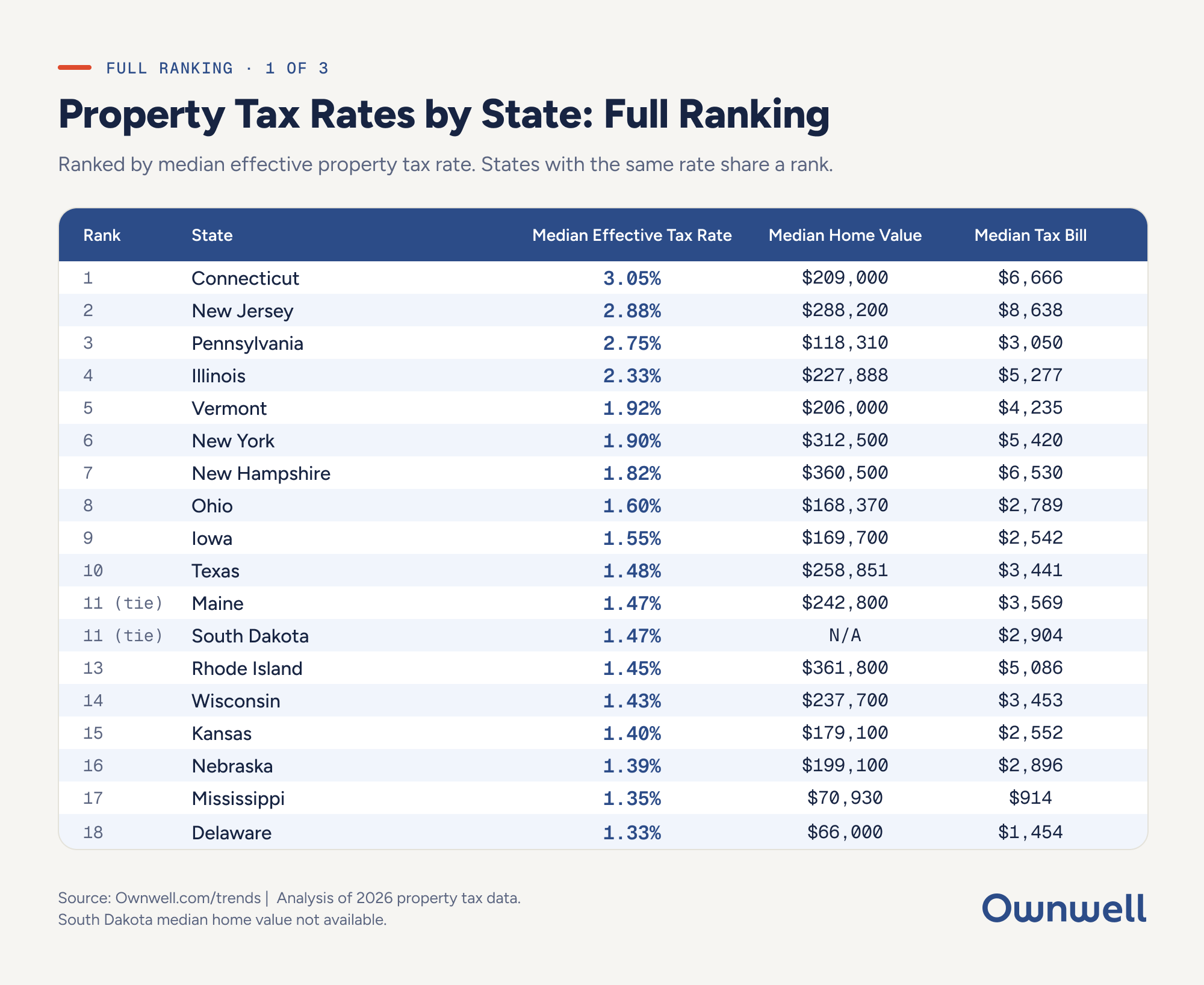
The reverse is also true. Mississippi ranks 17th at 1.35%, but a median home value of $70,930 keeps the median bill at $914, among the five lowest in the country.
New Jersey has the highest tax bills. Its median bill of $8,638 is the highest analyzed and nearly 14 times West Virginia's $629, the lowest.
Texas lands in the top 10. The state ranks 10th at 1.48% with a median bill of $3,441. Texas has no state income tax, so local governments and school districts lean heavily on property taxes.
How Much Are You Over Paying?
What Is a Median Effective Tax Rate?
A county or school district's tax rate is not the same as the share of a home's value an owner actually pays. Exemptions, deductions, assessment caps, and assessment ratios all shrink the final bill.
An effective tax rate captures that difference. It divides a home's actual tax bill by its market value as determined by the local assessor. A home valued at $300,000 with a $3,000 bill has an effective rate of one percent.
The median is the midpoint. In a state with a median effective rate of 1%, half of homes pay more than 1% of their value and half pay less. Using the median, instead of the average, keeps a handful of very high or very low bills from skewing a state's figure.
States With the Highest Property Tax Rates
Connecticut and New Jersey are the only states with median effective rates above 2.8%. New Jersey also has the highest median bill of any state in the ranking.
States With the Lowest Property Tax Rates
Six of the 10 lowest-rate states are in the West. Several of them, including Hawaii, Colorado, and Utah, also have some of the highest median home values in the ranking, which keeps their property tax bills well above what their rates alone suggest.
Your Neighbors Might Be Paying Less...
Property Tax Rates by State: Full Ranking
States are ranked from highest to lowest median effective property tax rate. States with the same rate share a rank.
Eighteen states have median effective rates above the 1.27% national median. Connecticut leads at 3.05%, and Delaware rounds out the group at 1.33%. These 18 states span 1.72 percentage points, the widest range of any group in the ranking.
Where Do Rates Sit Near the Middle?
Missouri is the first state below the national median, at 1.25%. From there, the field tightens. The next 16 states fall within 0.35 percentage points of each other, from 1.25% down to 0.90%. Florida, at 1.10%, sits at the exact middle of the 51-place ranking.
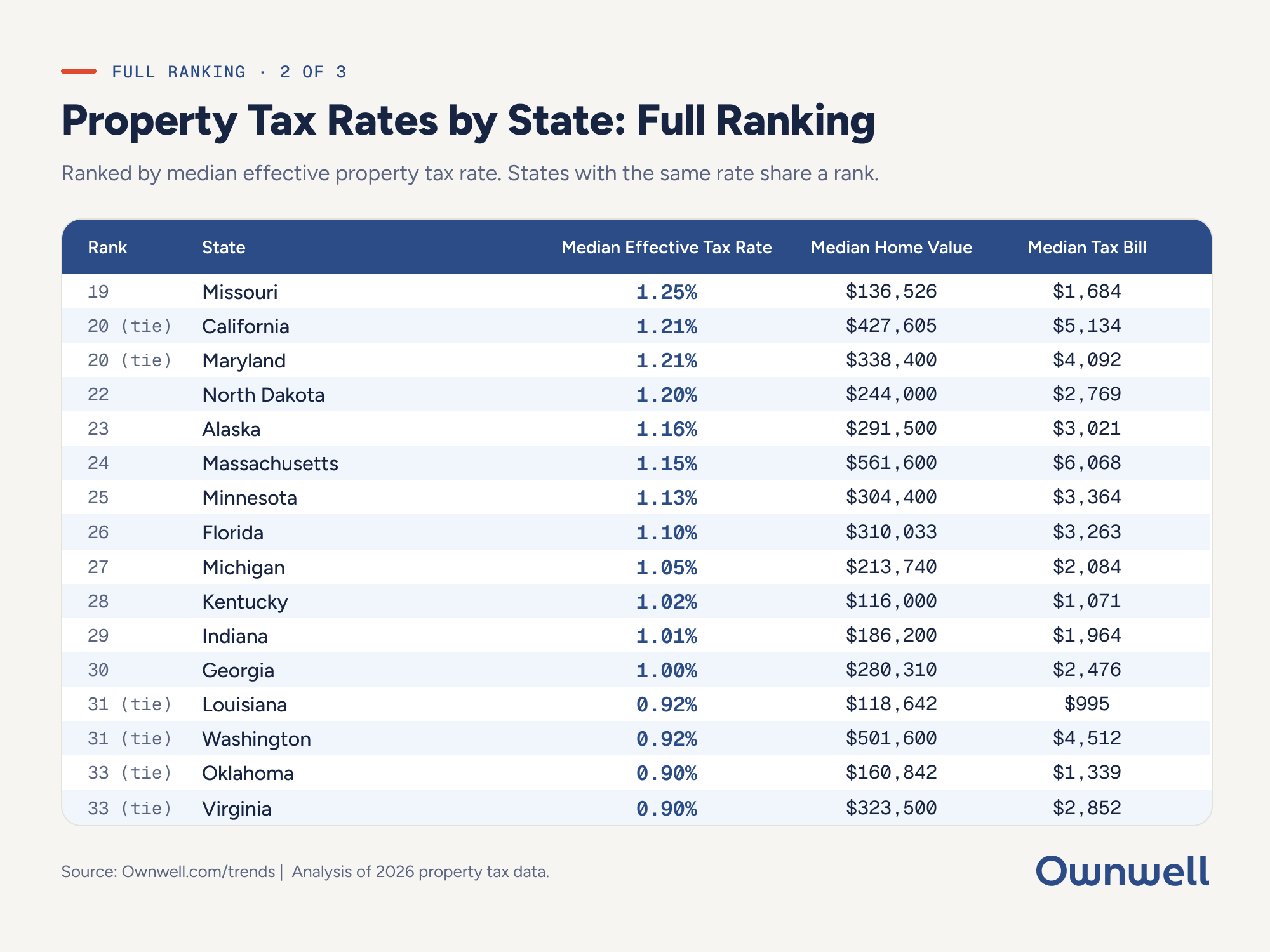
Which States Have the Lowest Property Tax Rates?
All 17 places in the bottom third of the ranking have median effective rates below 0.9%. Hawaii’s 0.31% is the lowest in the country.
However, a low rate still doesn’t guarantee a small bill.
Washington, D.C., ranks 40th at 0.78%, yet its median bill of $4,225 is more than four times Mississippi’s $914, even though Mississippi’s rate is 1.35%.
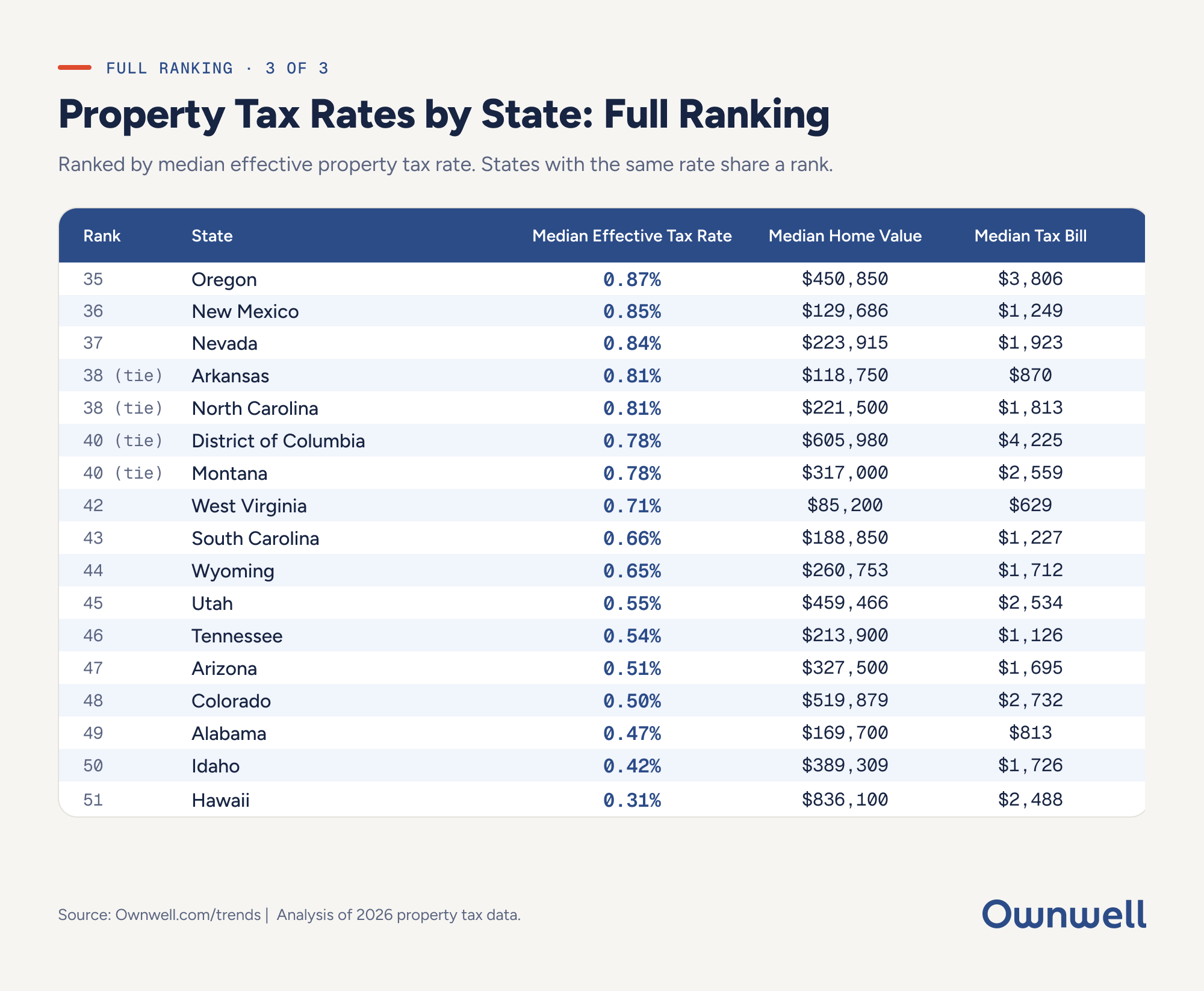
Source: Ownwell Trends. South Dakota median home value not available; see methodology.
Why Property Tax Rates Vary So Much by State
Property taxes are set locally, not nationally. School districts, counties, cities, and special districts each add their own rate, and you pay the total. That local structure drives the wide variation you see across states.
These taxes are the backbone of local budgets. Property taxes are the largest source of local tax revenue, making up 70% of local tax collections and 28.9% of total state and local tax collections in the United States, more than any other source of tax revenue.
Rates also reflect each area's budget needs, home values, and whether a state relies more on property tax or on income and sales taxes.
Reassessment frequency differs too. Some states reassess annually, others every few years. If you have a mortgage, your lender usually pays the bill through escrow; if you own your home outright, you pay the county directly on its due date.
Why January 1st Matters for Next Year's Bill
A tax bill comes from two numbers: the rate and the value it applies to. Local governments set rates, but the assessor sets the value, and in many states, that value is tied to a single date.
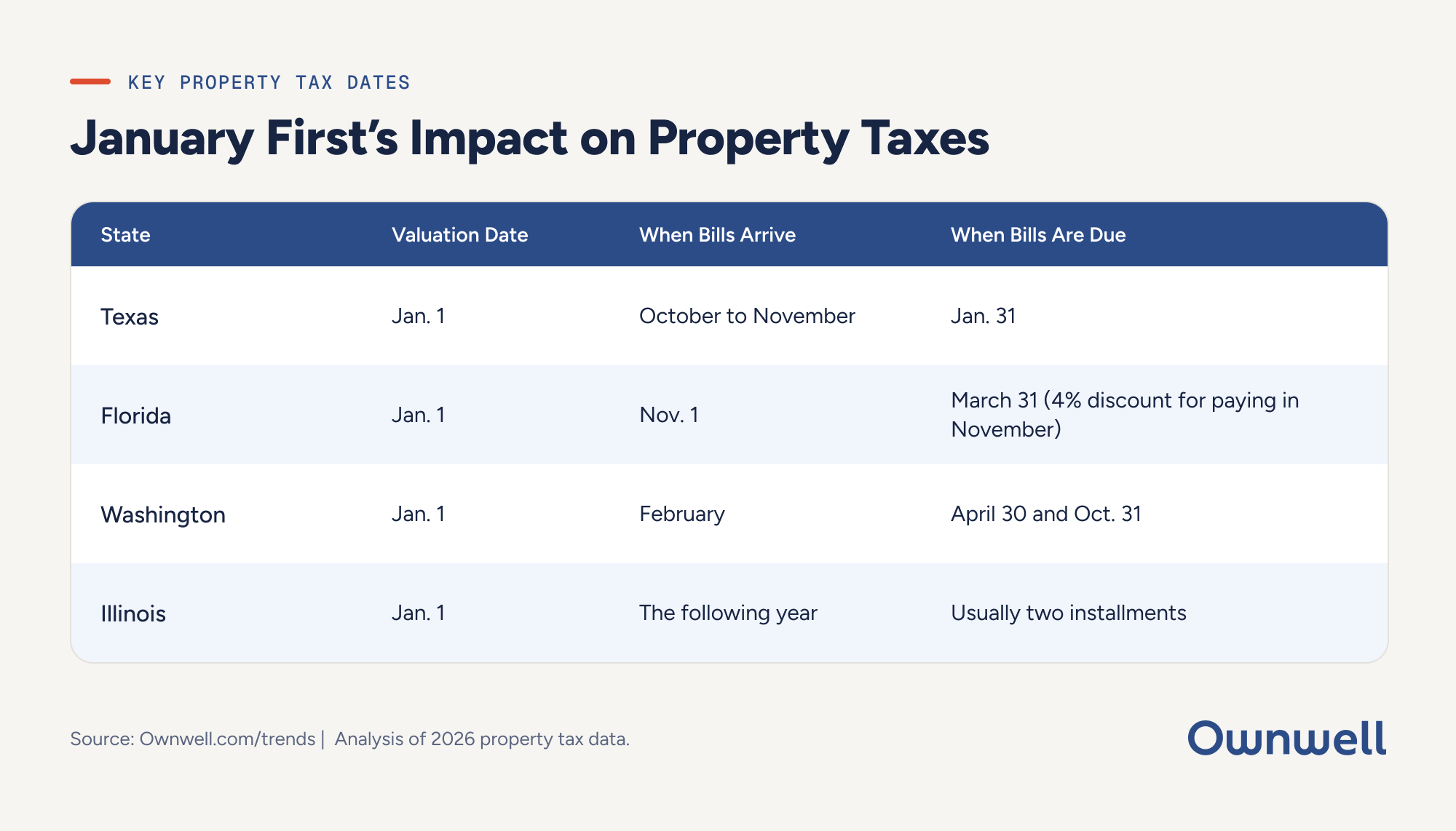
In Texas, for example, appraisal districts value every property at full market value as of January 1. Owners receive a notice of appraised value in the spring and generally have until May 15, or 30 days after the notice is mailed, to protest it.
Not every state works this way. Colorado values homes as of June 30 of the prior even year and reappraises every two years, so 2025 and 2026 bills both rest on a June 30, 2024, value. In New York, the key date is the March 1 taxable status date for most counties.
For homeowners, the practical step is the same almost everywhere: When the assessment notice arrives, check the listed value and property details, such as square footage, against what you know about the home.
In many states, the window to appeal an assessment opens with that notice and can close within only a few weeks.
How Ownwell Can Help Homeowners and Property Owners
We manage property tax appeals and exemptions end to end across our nine service states, pairing local tax experts with proprietary software so you don't have to build the case yourself. When you're ready, you can file a property tax appeal with us in minutes.
Our results speak for themselves: 88% of our customers receive a reduction, with average annual savings of $774. Thanks to our contingency-based pricing, you only pay if you save.
And if you’re not in one of our full-service states, we offer free appeal packets in over 1,700 counties (and growing)!
Methodology
Ownwell calculated each state's median effective property tax rate by dividing each home's property tax bill by its market value as determined by the local assessor, then taking the median across homes in the state.
Because the rate is based on the final bill, it reflects exemptions, deductions, and assessment limits. Median home values and median tax bills come from the same assessor and tax bill data.
Figures are for tax year 2026. Ownwell's South Dakota data is less complete than in other states, so read it with caution; we did not have a median home value. States with identical rates share a rank.
Full state-level data is available at ownwell.com/trends.